
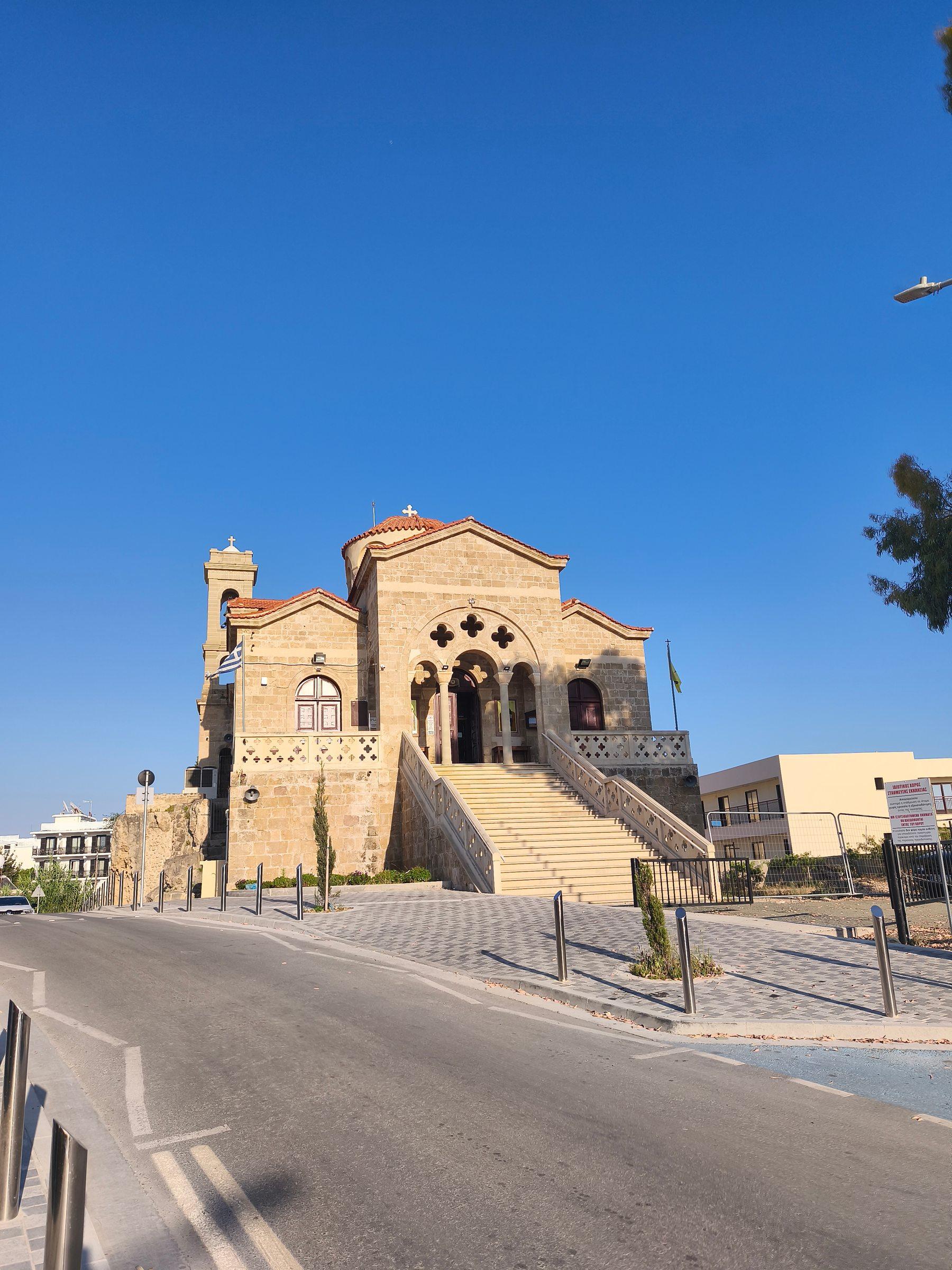
Main Description
On Apostolou Pavlou Avenue in Kato Paphos, a small Byzantine church sits on a rocky outcrop with the sea immediately below. Its name, Theoskepasti, means "Veiled by God". According to tradition, during the Arab raids that struck Cyprus repeatedly between the 7th and 9th centuries, a divine cloud descended and hid the church from the attackers, leaving it unharmed while other sites around it were destroyed.
Legend aside, a church has stood in some form on this rock for more than a thousand years, on a site that is at once exposed and sheltered. The rocky promontory on which it stands rises directly from the ground, with the water visible from its walls. Inside, the venerated icon of the Virgin — encased in a silver revetment and reputedly one of seventy icons attributed to the Evangelist Luke — draws pilgrims throughout the year.
The current building dates from 1923, when an earlier structure was substantially rebuilt, and was fully restored again in 2009. The architecture follows Byzantine tradition: a domed roof, a bell tower, an ornate iconostasis. It is an active parish church serving the community of Kato Paphos, with regular Sunday liturgy and a major feast on 15 August, the Dormition of the Virgin.
History
The site's association with the Virgin Mary and the legend of divine protection during Arab raids suggests an early Byzantine foundation, probably no later than the 9th century — the period when the raids were most intense and when miracle legends of church preservation are most commonly recorded in Cyprus. The specific form of the miracle here, a concealing cloud, has parallels in other Cypriot church traditions and reflects the theological importance placed on divine intervention in the island's survival of this period.
The church stood in some form through the medieval period, the Ottoman era, and into the modern age. By the early 20th century the building had deteriorated sufficiently to require substantial reconstruction; the 1923 rebuilding preserved the site and the venerated icon but replaced most of the original fabric. The 2009 restoration updated the interior and exterior to their present condition.
Architecture and Setting
The church is a small single-domed building with a bell tower, typical of post-Byzantine Orthodox ecclesiastical architecture in Cyprus. Its most distinctive feature is its setting: the rocky promontory on which it stands is a natural formation that gives the building an almost defensive character, elevated above the surrounding street level with the sea visible from its seaward face.
The interior contains an ornate iconostasis — the carved and gilded screen that separates the nave from the sanctuary in Orthodox churches — and painted walls. Given the 1923 reconstruction, the decoration is largely of the 20th century, though it follows traditional iconographic programmes.
The Icon
The church's principal treasure is an icon of the Virgin Mary described in local tradition as one of the seventy icons painted by the Evangelist Luke — a classification applied to a number of particularly venerated Marian icons across the Orthodox world. The icon is encased in a silver revetment (a protective metal cover leaving only the faces and hands of the depicted figures visible), the standard treatment for icons of special sanctity. It is the focus of pilgrimage on the feast of the Dormition, 15 August.
Описание
На проспекте Апостолу Павлу в Като-Пафос небольшая византийская церковь стоит на скальном выступе, под которым сразу начинается море. Название говорит само за себя: Феоскепасти означает «Покрытая Богом». По преданию, во время арабских набегов, неоднократно опустошавших Кипр в VII–IX веках, Божественное облако снизошло и скрыло церковь от захватчиков, сохранив её невредимой.
Как бы ни понимать легенду, за ней стоит факт: церковь в том или ином виде простояла здесь больше тысячи лет. Выступ поднимается прямо из земли, и вода видна от самых стен. Внутри — чтимая икона Богородицы в серебряной ризе; по преданию, она одна из семидесяти, написанных евангелистом Лукой. Паломники идут к ней круглый год.
Нынешнее здание относится к 1923 году, когда прежнюю постройку капитально перестроили; в 2009-м прошла полная реставрация. Архитектура византийской традиции — купольная кровля, колокольня, богатый иконостас внутри. Это действующий приходской храм. Литургия служится по воскресеньям, главный праздник — 15 августа, на Успение Пресвятой Богородицы.
История и образ
Связь места с Богородицей и предание о защите во время арабских набегов говорят о раннем византийском основании — вероятно, не позднее IX века, когда набеги были всего сильнее. Облако, скрывающее храм, встречается и в других кипрских преданиях того времени.
К началу XX века здание обветшало настолько, что потребовалась капитальная перестройка. Реконструкция 1923 года сохранила место и чтимую икону, но заменила большую часть постройки. Реставрация 2009 года привела интерьер и фасад к нынешнему виду.
Главное сокровище церкви — икона Богородицы. Местное предание относит её к семидесяти иконам письма евангелиста Луки. Икона заключена в серебряную ризу, и металл оставляет открытыми только лики и руки. Именно к ней в праздник Успения, 15 августа, стекаются паломники.
Περιγραφή
Επί της λεωφόρου Αποστόλου Παύλου στην Κάτω Πάφο, ένας μικρός βυζαντινός ναός είναι κτισμένος σε βραχώδες έξαρμα, με τη θάλασσα ακριβώς από κάτω. Θεοσκέπαστη σημαίνει σκεπασμένη από τον Θεό. Κατά την παράδοση, στη διάρκεια των αραβικών επιδρομών που έπληξαν επανειλημμένα την Κύπρο μεταξύ 7ου και 9ου αιώνα, ένα θεϊκό σύννεφο κατέβηκε και έκρυψε τον ναό από τους επιδρομείς, αφήνοντάς τον ανέπαφο.
Πίσω από τον θρύλο υπάρχει ένα γεγονός: ο ναός στέκει εδώ, με τη μία ή την άλλη μορφή, πάνω από χίλια χρόνια. Το βραχώδες έξαρμα υψώνεται απευθείας από το έδαφος και το νερό φαίνεται από τους ίδιους τους τοίχους. Στο εσωτερικό, η σεβάσμια εικόνα της Παναγίας, ντυμένη με ασημένια επένδυση και κατά την παράδοση μία από τις εβδομήντα εικόνες που αποδίδονται στον Ευαγγελιστή Λουκά, προσελκύει προσκυνητές όλο τον χρόνο.
Το σημερινό κτίσμα ανάγεται στο 1923, όταν ο παλαιότερος ναός ανοικοδομήθηκε ριζικά· ακολούθησε πλήρης αναστήλωση το 2009. Η αρχιτεκτονική ακολουθεί τη βυζαντινή παράδοση, με τρούλο και καμπαναριό, και περίτεχνο τέμπλο στο εσωτερικό. Ο ναός είναι ενοριακός και ενεργός, με τακτική Κυριακάτικη Θεία Λειτουργία και μεγάλη εορτή στις 15 Αυγούστου, την Κοίμηση της Θεοτόκου.
Ιστορία και εικόνα
Η σύνδεση του τόπου με την Παναγία και ο θρύλος της θείας προστασίας στις αραβικές επιδρομές δείχνουν πρώιμη βυζαντινή ίδρυση, πιθανώς όχι αργότερα από τον 9ο αιώνα, όταν οι επιδρομές ήταν εντονότερες. Το σύννεφο που κρύβει τον ναό επανέρχεται και σε άλλες κυπριακές εκκλησιαστικές παραδόσεις της ίδιας περιόδου.
Στις αρχές του 20ού αιώνα το κτίσμα είχε φθαρεί αρκετά ώστε να απαιτεί ριζική ανοικοδόμηση· η ανακατασκευή του 1923 διατήρησε τον τόπο και τη σεβάσμια εικόνα, αντικαθιστώντας όμως το μεγαλύτερο μέρος της κατασκευής. Η αναστήλωση του 2009 διαμόρφωσε το εσωτερικό και το εξωτερικό στη σημερινή τους μορφή.
Ο κύριος θησαυρός του ναού είναι η εικόνα της Παναγίας, την οποία η τοπική παράδοση κατατάσσει στις εβδομήντα εικόνες που ζωγράφισε ο Ευαγγελιστής Λουκάς. Η εικόνα είναι ντυμένη με ασημένια επένδυση: το μεταλλικό πλαίσιο αφήνει ακάλυπτα μόνο τα πρόσωπα και τα χέρια των εικονιζόμενων μορφών. Σε αυτήν συρρέουν οι προσκυνητές κατά την εορτή της Κοιμήσεως, στις 15 Αυγούστου.